The Short Answer
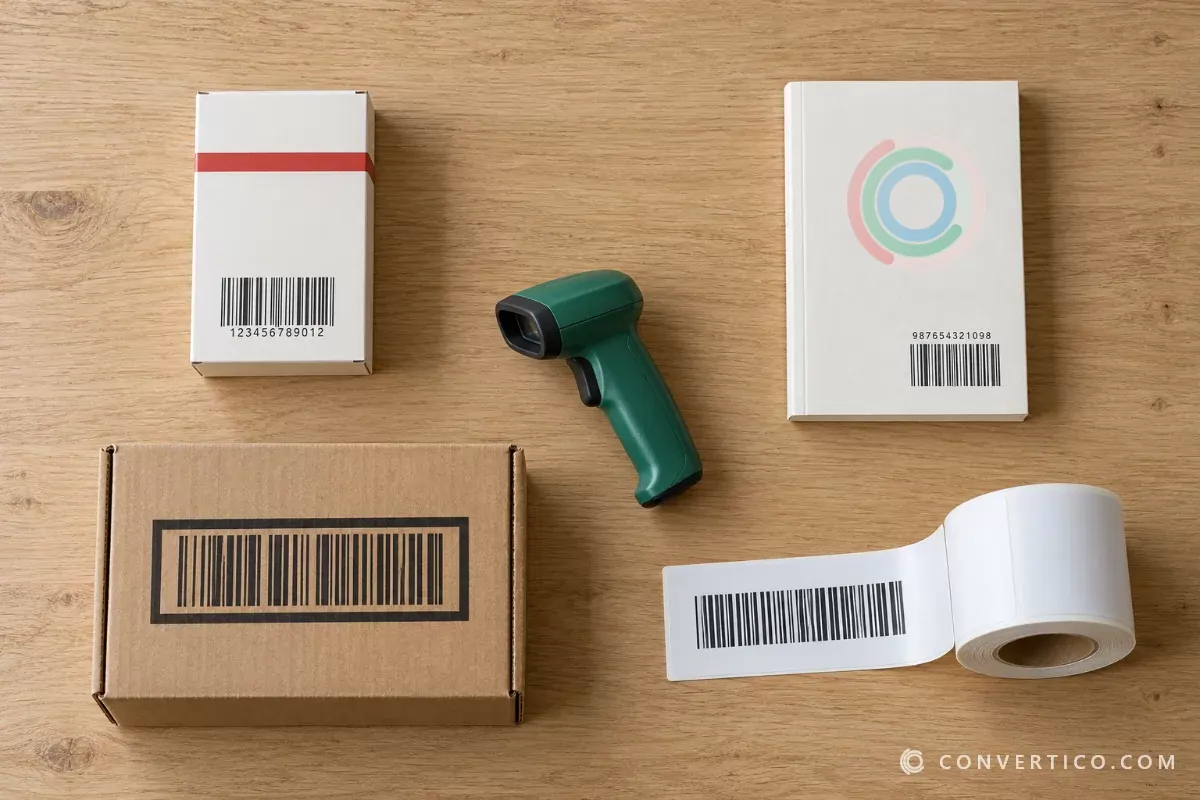
Use EAN-13 for retail products almost everywhere, UPC-A in the US and Canada, and ISBN for books.
For anything with letters - stock numbers, serials, Amazon FNSKU labels - use Code 128.
Shipping labels use GS1-128, outer cartons use ITF-14, and links or WiFi logins belong in a QR code, not a barcode.
You can make all of them, at the true print size, with the free Barcode Generator.
All Barcode Types at a Glance

| Type | Holds | Used for |
|---|---|---|
| EAN-13 | 13 digits | Retail products worldwide |
| UPC-A | 12 digits | Retail products in the US and Canada |
| EAN-8 | 8 digits | Very small packs |
| UPC-E | 8 digits (a shortened UPC-A) | Small packs in the US - cans, gum |
| ISBN | 13 digits starting 978 or 979 | Books (an EAN-13 with the ISBN above) |
| Code 128 | Any text, up to about 80 characters | Stock, serial numbers, Amazon FNSKU, asset tags |
| GS1-128 | Product number, dates, lot, serial | Pallets, cases, food and medicine |
| Code 39 | A-Z, 0-9 and 7 symbols | Older industrial systems, ID badges |
| ITF-14 | 14 digits | Corrugated cartons and cases |
| Data Matrix | Up to ~1,500 characters in a small square | Electronics, small parts, medicine packs |
| GS1 Digital Link QR | A web link with the GTIN, lot and dates | Retail packs, moving in by 2027 |
Retail Barcodes: EAN and UPC
EAN-13 is the barcode on almost every product in the world. Its 13 digits are a GTIN (Global Trade Item Number): a company prefix, an item number and a check digit.
UPC-A is the American original with 12 digits. It is really an EAN-13 that starts with 0, which is why every scanner reads both, and US shops have accepted EAN-13 since 2005.
EAN-8 and UPC-E are short versions for tiny packs. UPC-E only works for UPC-A numbers with enough zeros in the right places - the generator tells you when yours can be shortened.
You cannot make up a retail number. Shops and marketplaces check that the number belongs to your company. You get your numbers from GS1, the not-for-profit that runs the system, in your country. Barcodes for your own stock, assets and shipping need no registration.
Make one: EAN-13 barcode or UPC-A barcode.
Book Barcodes: ISBN
A book barcode is an EAN-13 whose number is the 13-digit ISBN, starting with 978 or 979 - publishers call this the "Bookland" prefix.
The ISBN is printed in a line above the bars, usually with hyphens between the parts. Old 10-digit ISBNs are converted by adding 978 at the front and working out a new check digit.
The small extra barcode on the right is an add-on: 5 digits for the price on books (51299 means US$12.99; the first digit is the currency) or 2 digits for a magazine's issue number.
The ISBN barcode generator converts ISBN-10 for you, keeps your hyphens if you type them, adds the price add-on and can print the digits in the classic OCR-B font.
Code 128: The All-Rounder
Code 128 can hold all 128 ASCII characters - capitals, lowercase, digits and symbols - and it packs long runs of digits two per symbol, so it stays compact.
It is the standard for warehouse labels, serial numbers, library cards and asset tags. Amazon's FNSKU labels (the codes starting with X00) are Code 128 too.
Need hundreds? The Code 128 generator makes a numbered series like PART-0001 to PART-0500 and prints them on Avery label sheets.
Shipping Barcodes: GS1-128 and ITF-14
GS1-128 is Code 128 with a special start character (FNC1) that tells the scanner the data follows the GS1 rules. Each piece of data starts with an application identifier (AI) in brackets:
- (01) - the product number (GTIN-14)
- (17) - use-by date, YYMMDD
- (10) - batch or lot number
- (21) - serial number
- (00) - SSCC, the number of one pallet or parcel
ITF-14 carries the 14-digit number of an outer carton. Its thick bearer frame stops a scanner from reading half the code when the print on cardboard is rough.
Code 39: The Veteran
Code 39 was the first barcode that could hold letters, and it is still used in factories, the car industry, the US military and on ID badges.
It holds only capitals, digits, space and - . $ / + %, and gets wide quickly. Each code starts and ends with an asterisk. For anything new, Code 128 is shorter and more flexible.
How the Check Digit Works
The last digit of an EAN, UPC, ISBN or ITF-14 number is a check digit, worked out from the others so a scanner can catch a misread.
For EAN-13 590123412345:
- Multiply the digits by 1 and 3 in turn, from the left: 5x1 + 9x3 + 0x1 + 1x3 + 2x1 + 3x3 + 4x1 + 1x3 + 2x1 + 3x3 + 4x1 + 5x3.
- Add them up: 83.
- The check digit is what you add to reach the next multiple of 10: 90 - 83 = 7.
So the full number is 5901234123457. The Barcode Generator does this for you - type the number without the last digit and it adds it, or type it all and it tells you if the last digit is wrong.
Size, Colour and Printing
- Size: retail barcodes come in magnifications from 80% to 200%. At 100%, an EAN-13 is 37.29 x 25.93 mm including the white margins. Do not go below 80%.
- Height: do not cut the bars shorter - shortened codes are hard to scan at an angle.
- White margins: leave clear space on both sides of the bars. Text or a box edge too close makes the code unreadable.
- Colour: dark bars on a light background. Red, orange and yellow bars disappear under the red light of shop scanners.
- Files: send PDF or EPS to a printer, use PNG at 300 dpi or more for labels. Print at 100%, never "fit to page".
Check before you print a thousand. Scan one test print with your phone or our QR Code Scanner, which reads EAN, UPC and Code 128 barcodes from a photo or screenshot too.
A Short History of the Barcode
In 1949, Norman Joseph Woodland and Bernard Silver filed a patent for a round "bullseye" code. Woodland said the idea came on a beach, when he pulled Morse code dots and dashes in the sand into long lines. The patent was granted in 1952, but the scanners of the time could not read it reliably.
In 1973 the US grocery industry chose the Universal Product Code, a rectangular design worked out by George Laurer at IBM. On 26 June 1974, a pack of Wrigley's Juicy Fruit gum became the first product scanned at a till, in a Marsh supermarket in Troy, Ohio.
Europe followed with the 13-digit EAN in 1977. Code 39 (1974) and Code 128 (1981) brought letters to barcodes, and in 2005 the European and American bodies merged into GS1, which runs product numbers worldwide today.
The next step is already here: GS1 is moving retail to 2D codes such as QR and Data Matrix, which can carry a link, a batch number and an expiry date. A GS1 Digital Link QR code holds a web address with the product number inside, so the till reads the GTIN and a shopper's phone opens the product page. You can make both with the Barcode Generator. Curious how QR codes work inside? Read how QR codes work.
Make a Barcode at the True Print Size
EAN, UPC, ISBN, Code 128, GS1-128, Code 39 and ITF-14 - check digits added for you. PNG, SVG, EPS, PDF and label sheets, free.
Barcode GeneratorFrequently Asked Questions
What is the most common type of barcode?
EAN-13 (and UPC-A in North America) - it is on almost every retail product. In warehouses and logistics, Code 128 is the most common.
What is the difference between UPC and EAN?
UPC-A has 12 digits and comes from the US; EAN-13 has 13 digits and is used worldwide. A UPC-A is an EAN-13 with a leading 0, so scanners read both.
Which barcode does Amazon use?
Products need a GTIN, usually a UPC or EAN registered with GS1. Amazon FNSKU labels for FBA stock are Code 128.
Can I make my own barcode for free?
Yes - the image is free to make. For retail products, though, the number inside must be registered to your company through GS1.
What barcode do books use?
An EAN-13 that contains the 13-digit ISBN, starting with 978 or 979, with the ISBN printed above the bars.
What is a check digit?
The last digit of an EAN, UPC, ISBN or ITF-14 number. It is calculated from the other digits so scanners can catch misreads.
Can a barcode be any colour?
Bars must be dark and the background light. Avoid red, orange and yellow bars - shop scanners use red light and cannot see them.
Still stuck? Ask us - we reply faster than a JPEG loads on dial-up.
The Bottom Line
- EAN-13 or UPC-A for products, ISBN for books
- Code 128 for anything with letters, including FNSKU
- GS1-128 and ITF-14 for shipping
- Retail numbers come from GS1 - the barcode image is free
- Dark bars, light background, full height, white margins